School Management System
La Fondazione Arte della Seta LISIO è un ente culturale senza scopo di lucro che ha come obiettivo primario quello di tramandare le antiche tecniche di tessitura a mano attraverso tre aree: l’area didattica con percorsi di formazione a catalogo e personalizzati, l’area culturale con l’organizzazione di eventi e prodotti editoriali e l’area manifatturiera con lo scopo di mantenere viva l’arte della tessitura di stoffe di pregio.
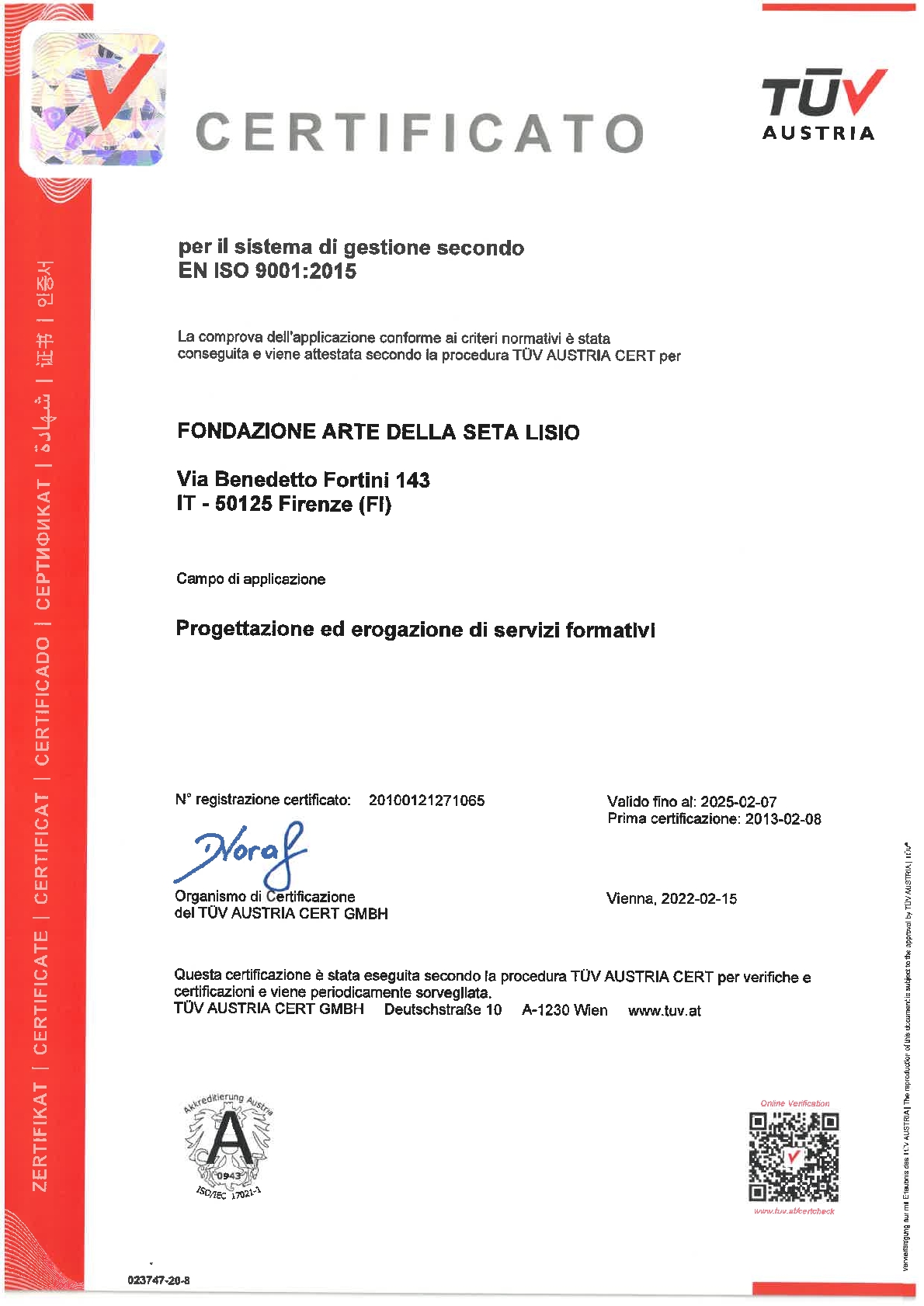
La Fondazione Arte della Seta LISIO individua nell’adozione di un SISTEMA DI GESTIONE PER LA QUALITÀ conforme allo standard ISO 9001 lo strumento utile al perseguimento di un rapporto di soddisfazione tra utente, organizzazione e altre parti interessate (enti pubblici, enti privati, organi di controllo, personale, docenti e
QUALITY POLICY
The organization’s strategic approach is based on the following objectives:
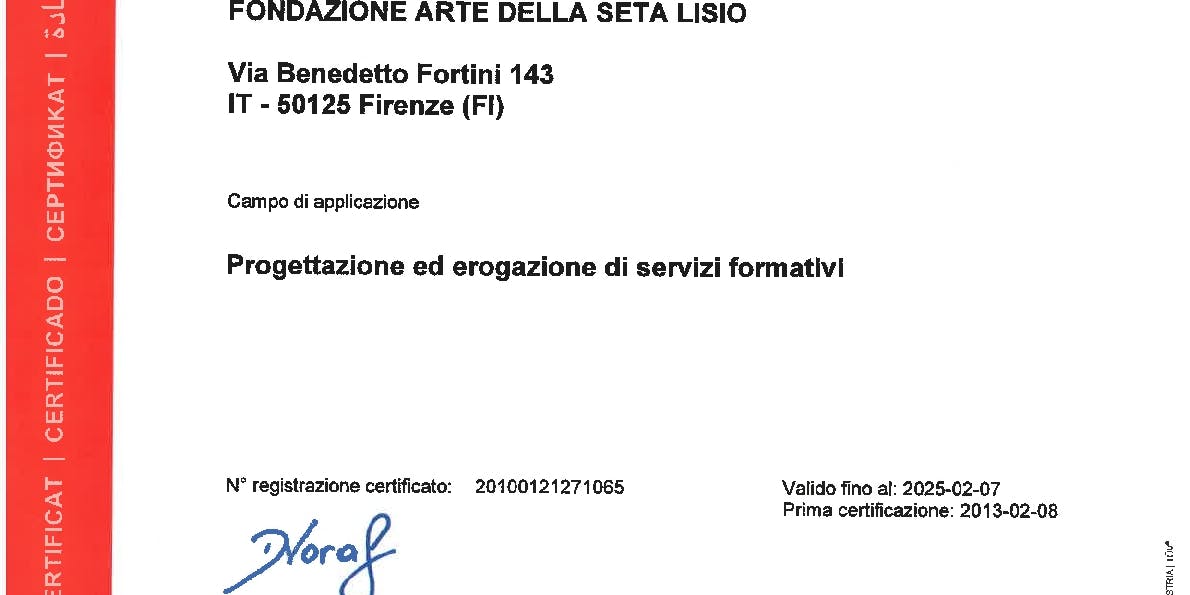
- Maintaining the certification of the Quality Management System according to the ISO 9001:2015 standard and maintaining the regional accreditation of the training agency.
- Developing new relationships and strengthening existing partnerships with the various stakeholders in the education and training sector.
- Optimizing resources and accessing new funding opportunities through PNRR calls aimed at training and digitalization processes, with a focus on environmental and social sustainability issues. (The Foundation has successfully participated, as part of partnerships, in two European calls involving the development and delivery of training programmes in the fields of craftsmanship and cultural institutions.)
- Training staff, enhancing professional knowledge and skills, increasing awareness, and encouraging the contribution of all stakeholders towards the continuous improvement of the quality system, effective process management, and customer satisfaction.
- Designing new training programmes based on the results of training needs analyses, the alignment between labour market demand and supply, and expressions of interest from the market and stakeholders (clients and partner companies).
The methodology adopted to implement an effective Quality Policy is summarized within the Quality Management System.
FUNDAMENTAL PRINCIPLES
The Service Charter represents the organization’s commitment to defining and safeguarding the rights of those who benefit from these services, according to the following fundamental principles:
Welcome and Inclusion
The organization is committed, through appropriate and effective attitudes and actions by all service staff, to promoting the welcome of users, their integration and inclusion, with particular attention to the educational guidance phase and access to training courses. In carrying out their activities, each staff member fully respects the rights and interests of the users.
Impartiality and Equality
In the delivery of services, the organization guarantees full equality of users’ rights. All users are assured objective and fair treatment by all staff members involved in the provision of the requested service.
Participation and Transparency
All staff members of the organization and users are active participants and responsible for the implementation of the “Charter,” and their conduct must contribute to achieving the general service standards. In order to encourage all forms of participation, the organization ensures maximum simplification of procedures and provides complete and transparent information. The Client has the right to request information concerning the service provided, submit proposals or suggestions, file complaints, and communicate their level of satisfaction.
Teaching Autonomy and Staff Training
The training programme ensures respect for the teaching autonomy of instructors and guarantees the beneficiaries’ education and development by supporting their potential growth and contributing to the professional development of individuals and their integration into the labour market. Continuous training and professional development represent a commitment for all staff members and a responsibility of the Training Agency, which ensures structured and regular initiatives.
Courtesy
L’Agenzia si impegna affinché i rapporti con i beneficiari siano improntati alla massima cortesia.
Efficiency and Effectiveness
The organization is committed to continuously pursuing objectives aimed at improving and optimizing the services provided, through the research and adoption of innovative technologies and solutions that make the service increasingly responsive to users’ expectations.
The methods adopted to implement an effective quality policy are the analysis, planning, definition, and monitoring of work processes, following a continuous improvement approach.
To this end, the Foundation is committed to the continuous improvement of its activities and services through the dissemination of these principles at all organizational levels, as well as through the constant review and evaluation of its Quality Policy and Quality Objectives.